15 May Wednesday
Mysterious cereals. Little jars of spice. Most of them were labeled at some point. Many of the labels fell off. Some of them contain a spice that is not the spice named on the label. I remember telling myself to remember that the Oregano is now Marjoram, then forgetting if that was the one that was changed or was it the dried chives. I dip my finger in and touch it to my tongue. Nothing. It doesn’t matter, it tastes only of dust now. Bottles and bottles of sauces and condiments. Enough mulling spice to host a Christmas party every week of the year. Four types of rice, five types of pasta, six types of flour. It’s nice to be spoiled for choice, it really is. Like anything else, it can be overwhelming. It’s also deep, my pantry that is, so to get the bread flour one must move three hundred other items. Pantry feng shui can be a challenge. You’ve heard this all from me before. But this is different. This is about ingredients that are labeled, that have flavor and are in great condition, I just don’t have any clue what to do with them. Let’s discuss a few.
Freekeh. A food of North African origin, it is toasted green durum wheat that is crushed. It is used in making all sorts of dishes, mostly as a grain side dish. What do you do? Well, before we all freak out, let’s do a little research. No one has more to say on this subject than Yotam Ottolenghi, one of the greats of our age. In his amazing book, Jerusalem, he has a number of recipes that have me real deal excited to eat this stuff. Spicy Freekeh soup with meatballs. Poached chicken with sweet-spiced Freekeh. I can also use it to produce falafel, which I’ve never made. That soup especially, that sounds like one tasty dish.
Course toasted semolina- I know this is your question, I know you. Benji, you don’t know how to use semolina? Yes, I’d snap defensively, yes I know how use semolina. But, course semolina? It looks different. A little quick research teaches me that course semolina is preferred for cakes, puddings, and items with longer cook times. Finer semolina (flour) is preferred for silky pastas and gnocchi. Lesson learned. It turns out that Ottolenghi has a recipe for Semolina, Marmalade, and Coconut cake, which sounds delightful. Also, a pair of semolina and date cakes in Paula Wolfert’s Cooking of the Eastern Mediterranean, another classic. I have a lot of dates too. The food, not the social outing. I have social dates too, but this is not dear diary.
Finally, what do you do with a giant sack of sesame seeds? Well, there are a million things, you just gotta do them. Sesame cookies, sesame balls, sesame seeds all over your bagels and buns. But I am thinking that I’m gonna take a crack at my own tahini. I mean, what could go wrong?
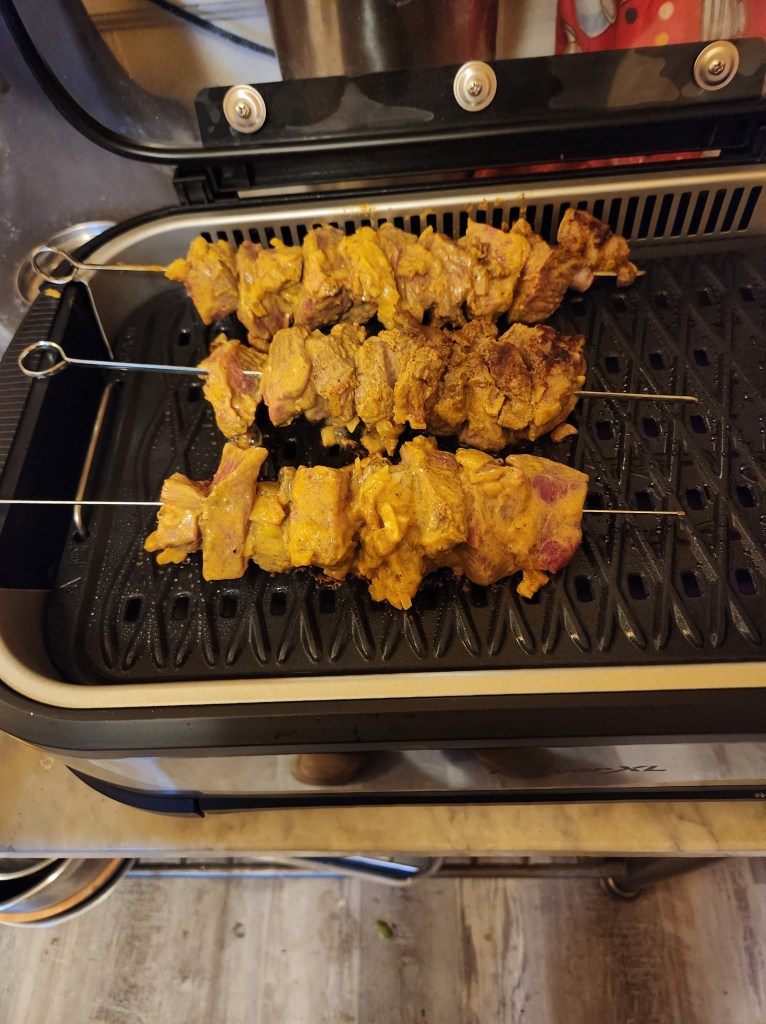
OK, that’s it, just wanted to share. It’s funny that lately my food exploration has turned decidedly to the Middle East and North Africa. Coincidence? Yes, I think so. You can’t decide to work on kebabs and not expect that many of the recipes would come from this region.
OK, that’s it. If you’ve read this far, you’ve reached the end of this post, congratulations. I hope you learned something new and are running to the nearest market to buy farm fresh ingredients which you are going to whip into the most delectable dishes smothered in this and that sauce, pulling hot loaves of crisp bread from the oven, trimming crust from the edge of a ready to bake pie crust, stirring deep kettles of fragrant stew with long ladles, cranking yellow roads of fresh pasta onto the marble countertop, swirling ivory castles of whipped cream out of thin air, basting roasting meats in their succulent juices, deftly cracking perfect eggs into batters and doughs. I hope you are doing that. Instead of reading this post, which substantively ended several paragraphs ago.
OK, that’s it, basically. Though, one thing. Earlier I wrote that Ottolenghi had more to say about freekeh than anyone else, and it occurs to me that it might not be true. I don’t know everyone, let alone people who know more about anything than anyone, let alone freekeh, and I’m comfortable extending that to the entire world of cereals and grains. I had a mildly paranoid fantasy that for some reason Ottolenghi read this blog entry and decided to sue me for defamation of character, not for misapprehending his knowledge of freekeh, but because his image is one of a humble man, not a braggard as I cast him.
OK, that’s it. Hope everyone is well. Family Feud coming on.










 BingoFest