It was really meant to be a joke, a little excuse to get together on a Thursday. An invitation-come over, we’ll watch the debate, have a drink, have a nibble, roll our eyes have a laugh. Order pizza? Nah, I’ll make something easy and fun and bring it over. OK, how bout this? I’ll make one dish for each of the candidates. It’ll be a riff on their names or their eating habits or something silly goose like that. Hmm…….There are numerous puns and plays for Joe, like a cup of Jo, Jojos, and of course, Sloppy Joes. For the other debater, I had a harder time. I did some careful thinking, avoiding fast-food related dishes and full-out low brow mockery. I allowed my mind to wander, and I reflected on colors and shapes, themes and ideas that characterize the other debater.
Dough Gods. A perfect metaphor for the other debater. The color on this snapshot is a little muted, but they were deep orange. They were amorphous and rotund. They were loaded with cheese. They were essentially cornmeal and cheese biscuits from Sally Schmitt’s Six California Kitchens, and describe their resemblance to dough gods, which is an euphemism for a pile of cow shit. Again, perfect.
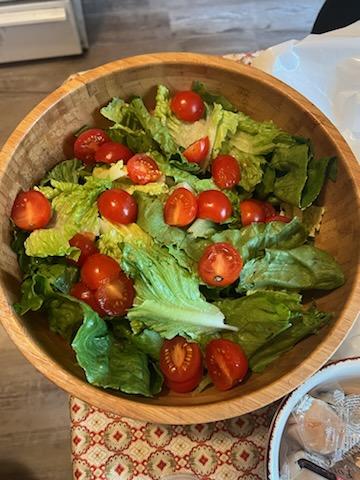
So, there it was. Sloppy Joes, Dough Gods, and as I described it, a green salad will tomato and herb vinaigrette for healing, hope, and peace.
It’s been a long time since I had a sloppy joe. My combo: ground beef, onion, celery, green pepper, ketchup, Worcestershire, Tabasco, salt and pepper. Simmered, served on a bun. Little did we know just how apt my choices would be.
Bullshit and cheese. Sloppy meat sandwiches. Yes. Well, this is not a political blog, it’s about food. This will be important to remember in the next several months. Something that brings friends together to have good food can’t be all bad can it? Maybe next time, we’ll do it in a fallout shelter.
Come on now kids, up at at ’em, a brand new summer just begun, just for you and me. Feeling relaxed, feeling renewed, feeling inspired, dreams are pursued. Let me take a little time and tell you a few things I’ve either learned or re-learned in the last two weeks kitchen-wise speaking, just in time for summer:
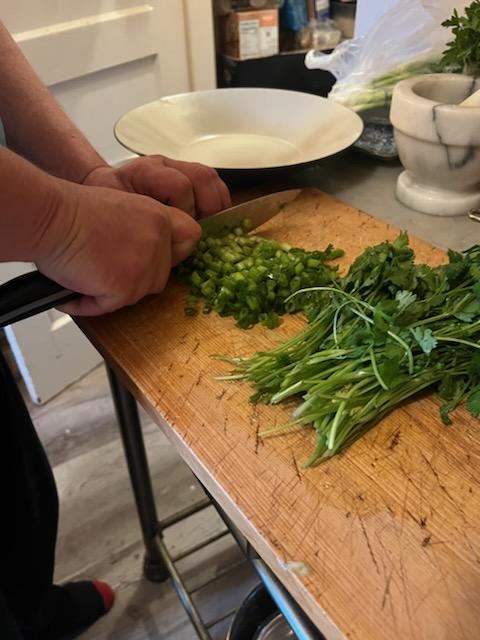
Chop your onions, chop your herbs.
Clean them well and chop with care. The shape, the size and the moisture of the herbs can change a dish, and ultimately, your life. It says a lot about one, really. Don’t use herb processing as an expression for your dormant rage, wildly hacking them to a pulp. Herbs lose their flavor this way and taste like grass clippings. Save your rage for mowing the lawn. Rinse and dry your parsley and cilantro thoroughly, and again, as soon as you get them safely home. Rinse, and I like to take them outside and shake vigorously and let em sit out for a bit. This time of year, everything is parsley and basil, tarragon and savory. How much spring onion is too much spring onion scattered on a dish? Has anyone ever discovered the answer to this question? This is the best time of year for fresh garlic too.
2. Little tomatoes are here.
Find a new way to dress them. Getting a salad dressing right really makes me feel like a man in a way few other things do, and my new favorite right is Miso dressing. Mirin, neutral oil, miso paste, sesame oil, soy sauce, sesame seeds, white pepper. Oh and yes, a little pinch of sugar. I was recently complimented on my salad dressings, and I was surprised how deeply I was moved by the words. I spent several minutes in silence.
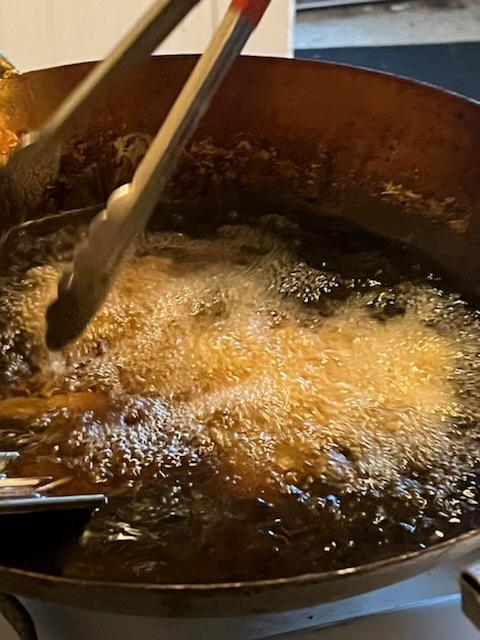
3. Straighten up and fry right.
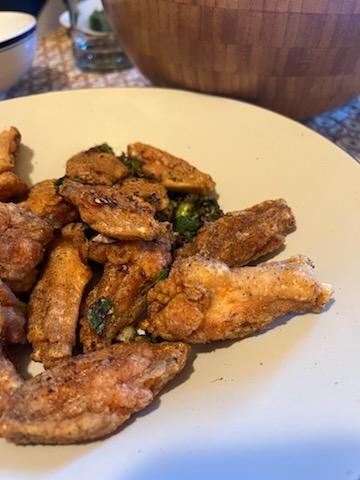
It’s the details in our work that can make a huge difference. This is my new thinking about deep frying. For thousands of years and across many different cultures and for many different reasons, grandmothers have been feeding their loved ones fried foods, like the salt and pepper chicken wings pictured above.
It is widely known now that deep frying is a unhealthy way of eating., which doesn’t sit well in the stomach with the notion that grandma’s cooking ways were best. Why did grandma do this? She hate us? Did she have a choice? Was there a way of frying that minimized the health downsides? Do yummy things just kill us quicker and that’s all there is to it? And what isn’t killing us, ultimately? Is it twisted logic to remind that more people have been killed across time from drinking water than from Nana’s Fritto Misto?
As far as I can tell, and this is not an academic paper, the fear of deep-fried foods corresponds with their presence in our every day lives vis-a-vis fast food and its numerous kissing cousins. Cheaper oils cooked at lower temps tossed in salt but never dried and tightened up caused many to lose their daddies earlier to early morning driveway heart attacks. So, naturally, bad. Cooking the materials at a higher temperature keeps the food from absorbing the oil, and drying on paper towels or some such thing after words removes any oil from the surface.
I toasted my spice mix, which is a personal variation of Kenji Lopez-Alt’s from The Wok cookbook. You can look that up yourself, but I’ll tell you I increase the amount of Sichuan pepper and cloves, and that’s basically my variation. I toasted them with the other ingredients (look it up) in a dry wok and carefully, so no one went running into the streets with burning eyes, you had to be there. Good times!
The temperature of the oil is paramount, and keeping the oil at the ideal temp is not something you can’t pay attention to. You can, you must. Don’t crowd the pan, cook a minute or two longer than you think you should. The food should be a dark golden brown. Then, dry it off with paper towels completely thoroughly. It tastes so good and has no grease on the outside, it’s dry and light crisp and salty spicy.
Take these broken wings and learn to fly.
4. Make the most of everything while we may.
I’d cooked a chicken and saved the carcass. I wrapped it in plastic, popped it in the fridge, and promptly forgot about it. When I noticed it was there too many days later, it was horribly useless, like an ancient rotting barn of dry grey planks you see from the highway. There’s no saving you baby!
So when I made my weekly chicken several days ago, I didn’t wait. I put it in the stock pot while my guests were still here! Next, I came into a glut of fresh summer basil that was clearly not going to survive the night. So, I made several jars of fresh pesto. Last night, dinnertime arrives, the wolves are gathering in the tummy. I heat some of the stock and I swirl in several tablespoons of pesto. This dish is profoundly delicious, maybe one of the most wonderful things I ever tasted.
It was the summer solstice. Windy cold grey in the outside. I took a warm bath, drank a large bowl of this deeply satisfying soup, and decided to pop on a movie. My app recommended in its featured classics, Don’t Look Now, starring Julie Christie and Donald Sutherland, who died yesterday. It is one of the most creepy strange movies I’ve ever seen, and I think for the time being at least, I won’t be able to eat pesto without thinking about this film. Most of the film takes place in Venice, so it was fitting that I had something Italianate on the tongue.
A really nifty cake from a really nifty gal called Grandma Rose, who had a cafe in Portland Oregon in the 60s-80s I guess, and she put out a couple of cookbooks that are real dandies. I made the Fresh Plum Sour Cream Cake with Streusel topping, which was more desserty than breakfasty type-a coffee cakey type-a thingy. It was served with a thick whip of creme fraiche. The only word that I could describe that wonderful consistency of creme fraiche is clabber. Clabber clabber clabber it’s the sound of the cream and sour cream slippity slopping around the bowl until it comes together in a noble emulsion of strength, gentility, extravagance, and humility all at once. This lightly tart cream on top of the sturdy cake, tart fruit, and toasted cinnamon caramel streusel made for real good eating. OK kids, stay cool out there, and remember, if you get hungry, eat something.
Let me tell you kids, it’s another scorcher by the bay. There is a pleasant breeze off the coast and the sun is at her blazing best. The sky is so perfectly cloudless I think I can see into deep space. It is a good time to be and do the simple. It is Wednesday, my special day to feel like a French woman, to saunter around the farmers market and be dismayed that the peaches are not quite ripe or the tomatoes have no scent.
This week has been a parade of yummy foods and happy meals. Fresh strawberry banana smoothies, baked chicken swaddled in cream and tangy mustard, fresh cherry tomato dressing, crisp salad greens, risotto. Rice in fact, a few times. Asparagus, height of season. All sorts of lemony things.
I must tell you I have always hated the word smoothie. It is a horrible word for a wonderful food stuff. Smoothie is a word that, to me, describes a con artist, or some young man that courts rich elderly widows.
Ha! I just looked it up. In British English a smoothie refers to a person who is polite and persuasive. Also, that He’s A Smoothie was the name of some kind of award-winning Canadian horse. In other words, it doesn’t uniquely describe a food, and these nifty not-just-for-breakfast drinks deserve one!
What could we call a smoothie instead? Something two syllables does seem appropriate. One syllable is too short, too sharp for the silken texture of the thing, like Slump or Grunt or Oat or Loaf- another horrible word. Too many syllables make it seem less serious, portmanteau that are almost as bad as smoothie. Fruigurtwhirlly. Yogwhispies. Fruipwhirls is OK. Yogswhirls? That’s better. Or just Yogu or Guyog or Gooyug. Go You! You Go, Gurl!! I guess smoothie is OK. I doubt even if I came up with a good name that anyone would start using it. I would need like, at least several million more subscribers and faithful readers to coin a new term, no?
Another classic from another time: James Beard’s amazing recipe for chicken breast baked with mushrooms, parsley, and dijon mustard. A naughty splash of cream, a little lemon juice at the end, and you got yourself one tasty dish there. Add some fluffy “dirty rice”. I put that in quotes cause it is really only partially dirtied.
Dirty rice, as it is called in Cajun cooking, is rice that is cooked in various organ meats and vegetables and of course, stock, and don’t forget the hot sauce! My dirty rice was meant to accompany a highly and singularly flavored dish with Dijon Mustard, and I didn’t want anything to interfere with that taste. In fact, in my original source material (The New James Beard 1981) the author specifically wrote that the chicken should be served with only plain boiled rice. Thing was, I already had a couple o’cups of chicken stock with some giblets I intended to make a gravy with a few nights before. The gravy never got made, in a story too boring to even mention. So, it was dirty in just that one way, like Uncle Gary.
Freshly boiled green beans, frantically tossed in black pepper and butter and lemon juice and a very interesting Cyprian lemon zest sea salt type thing make for a lovely salad. If Beethoven says “only the pure of heart can make a soup” then I’d assert that only the truly nervous can make a salad. It inspired me to write this poem:
I’ll tell you what June means to me,
She means green beans.
I means to tell you what me June,
this afternoon.
Again, the ole Forty-Nine bus whisked me off to civic center. Today, pretty standard fare. Fresh young golden potatoes, big fat leeks, perfect for the soup. Beautiful, tight heads of broccoli for a beef stir fry. Two enormous heads of Romaine, spring onions, garlic, and the amazing cherry tomatoes i found last time. I didn’t get any strawberries, I didn’t want to tempt fate with the bus on this particularly hot day. You know what heat does to strawberries? With people, it’s even worse! And another thing-the Civic Center Farmer’s Market is in the middle of an open area with absolutely no trees. Even at 8:30 in the morning when I was there it was full sun exposure. Merciless.
My Apartment has basically a north- south orientation, with the rest of my building to the east and the building next door to the west. This means that I get interesting slivers of sunlight both in my parlor (morning) and kitchen (afternoon) but that everything in-between is in permanent twilight or gets no sun at all, like my hallway. It’s nice to lie down on the floor there on really hot day like today.
Oh the heavenly scent of leeks cooking in butter! Is there anything better? I feel another poem coming on:
Amidst the fevered foodie freaks,
and even grander gourmet geeks,
Some Italians, many Greeks
humble peasants, fancy sheiks,
could expound for weeks and weeks
about undying love of leeks.
So, if your heart is feeling weak,
and your figure’s less than sleek,
and the prospect’s pretty bleak,
and your life-style needs a tweak.
Here’s the answer that you seek:
I suggest you eat a leek.
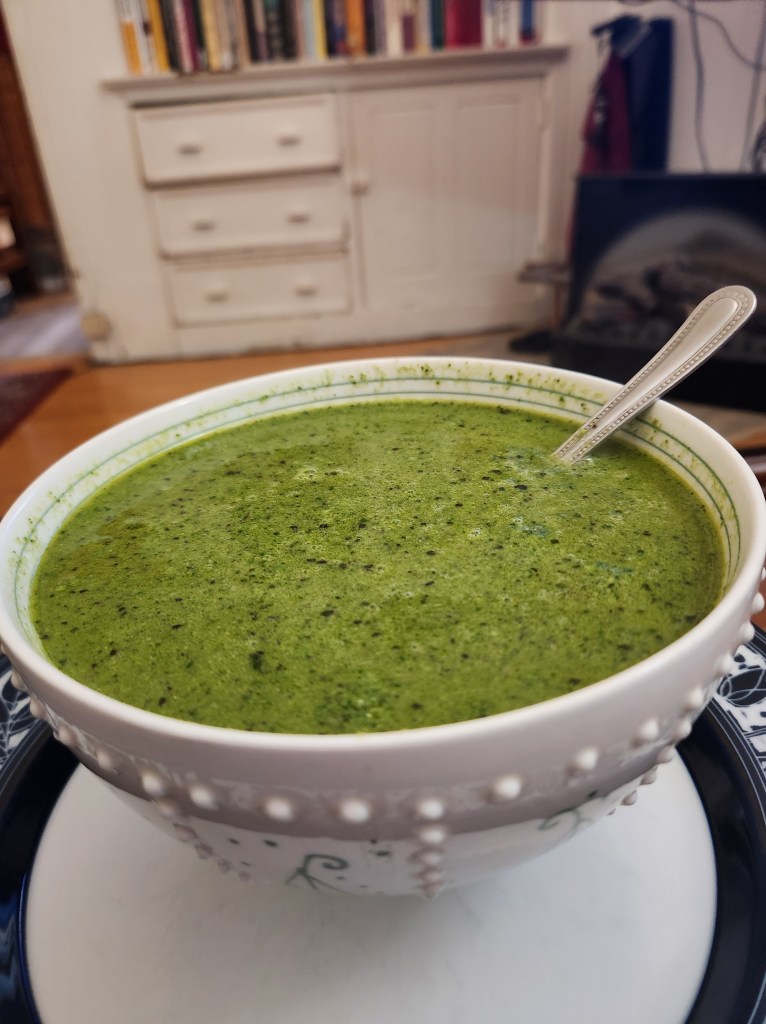
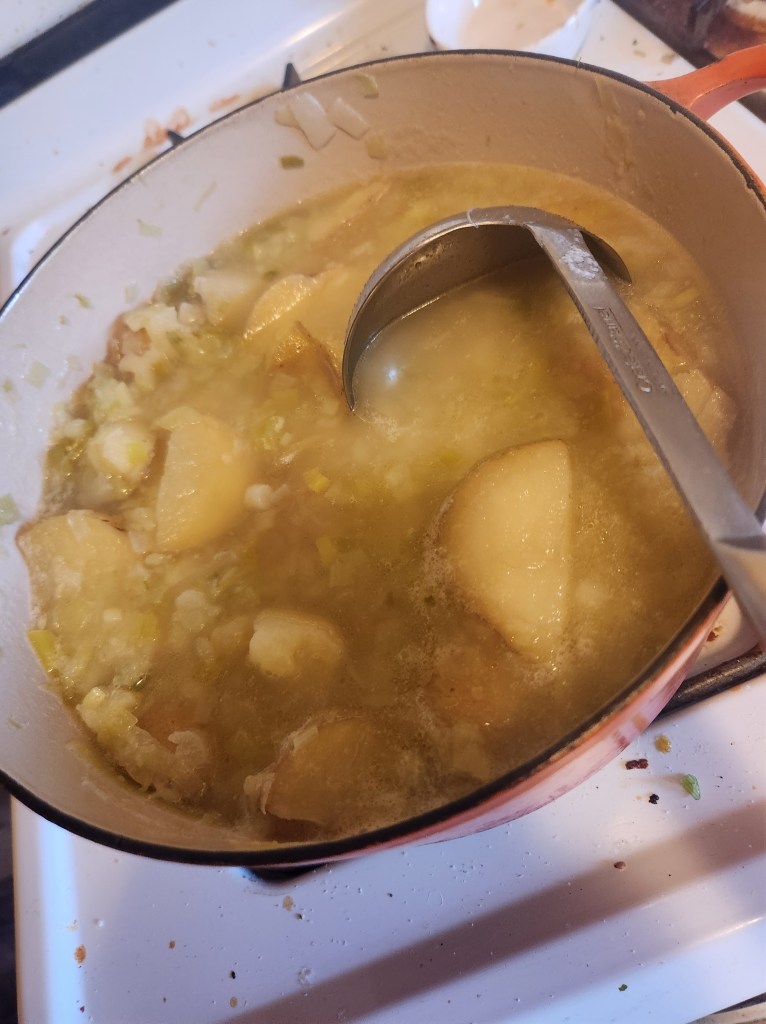
The first recipe in Mastering the Art of French cooking is for Leek and Potato Soup, or as the French call it, Potage Parmentier. Dear Julia explained that this dish is everything wonderful about French cuisine. Very few, simple ingredients cooked carefully to velvet emulsion with butter. It is so delicious that is surprises people when they ask what’s in it. Leeks, potatoes, water, butter, salt, pepper.
Here are some fun leek facts you can share with your family and friends. You could even make a fun leek trivia.
What do the French call leeks, informally? Because leeks grow plentifully in damp soil and swamps, it was called asperges du pauvre, asparagus of the poor.
Where does the word leek come from? It is an old English word that originally meant garlic.
What is the only vegetable that has a major city named for it? The leek.
What city is it? Chicago, an Algonquin word meaning striped onion or wild leek, which once grew in the enormous swamp on which the city is built.
Enough. Play the game, eat the soup, have a good time.
Monday is my work from home sorta day, I reply to emails, review dates and meetings and plans for the week, do chores, make sure money gets shuffled around to where it’s supposed to go, and the other thrilling minutiae of self-sufficiency. When days are slow and it’s dishes and vacuuming and laundry, I’ll put on a “stupid” movie channel as my grandfather would’ve called it, and let it play away. My favorite at the moment is COMET, featuring sci-fi, thrillers and horror, many of the B variety. And tonight’s prime-time flick is a new one to me. The Roger Corman(RIP) produced, Harvey Korman starring (in two roles), 1986 masterpiece, Munchies. It is a riff, a take, a what do you call it? Rip off of Gremlins, except it’s much funnier and deliberately goofy. It gets bad reviews everywhere, and they are undeserved, this is a funny movie and a terrific picture, in a trashy, silly rip-off, low-brow sort of way. The puppets are hilariously cheap looking, the budget constraints painfully obvious.
Now, why am I sharing this movie news on my little food nibble bloggy woggy? I don’t honestly know, it was the only big thing that happened in my life today. Didn’t Don Delillo write that there used to be a thing called taste? Andy Warhol changed all that. Now there is camp, there is kitsch. It became ok to love things done in poor taste, things so bad they are good. I didn’t put quotes around it because it’s not an exact quote. I’m not even sure that it is Delillo, but I’m pretty sure. I don’t have time to go hunting around for it. Also, please don’t get hung up on the Andy Warhol part, it doesn’t matter for my purposes that we identify the person that did this, it is important to acknowledge that it has happened. This wider acceptance of stuff that we all know isn’t good (movies and tv lend themselves well to this acceptance) is a new and fun thing. It brings people with bad taste together without shame. This is true also in the world of food and drink.
I speak not of nostalgia. Neither speak I of reconstructed or deconstructed versions of dishes. Or real fancy versions of typically pedestrian victuals, I’m talking about genuine trash foods. Like, I had a friend that made a dish every Christmas that was intended to look like his kittycat had made lots of poopies in a pan of that mini gravel crap that gets all over the house of anyone that has a cat. I think it’s like little fudge clumps in crumbled-up oreos or something horrible like that. That’s an extreme example. Another example is serving carnival food at dinner parties.
High spring fog moves in over our peninsula. Anyway, here comes another one. I’m talking about really fancy $$$ gala dinner parties for private donors, special friends of private donors dinner parties, and private friend diners of donor dinners. A cotton candy machine. Donuts and waffles fried on demand. Hush puppies. Corn dogs. Yes, yes, the ole corn dog, she was barking up my pant leg the other day, but I shook her. A friend’s birthday request for deep fried goodies went awry when I fell asleep, a putrid and peaceless sleep indeed. I awoke twenty minutes before guests arrived having prepared exactly nothing. I’m glad I didn’t turn the oil on before I snoozed. I guess I don’t really care right now. I was happy. Guests were happy. Hot dogs (Hebrew National) on grilled bleach-white buns, simmered onions, hot sauerkraut, and mustard. Magnificence on a bun.
I’m sorry I called it trash food, it isn’t. Cotton Candy is trash food, my buddy’s kitty litter snack is trash. Is it? Does that make it bad? This Harvey Korman movie is bad, but I’d recommend it to anyone. In fact, I am recommending it to everyone. I hope they see this. Munchies, the little monsters that eat and prank and maybe even kill their way through Southern California desert towns.
Night descends on the quiet city. Let’s contemplate potato salad together. I remember the first time I ate potato salad. It was made by my grandmother or perhaps someone else, but it was definitely someone, and it was cold and quite mayonnaise-y, with thick chunks of celery in it. I remember a friend making a large bowl of her “special” potato salad for a picnic in high school. I don’t remember what was special about it except that it didn’t smell great, it doubled as an ash tray when no other was at hand, her constantly shedding cat loved hopping on and off the kitchen counter, and I always gave it a miss. Potato salads show up everywhere- a dish that seems to cross class lines, which doesn’t happen that often. Here’s what I did with mine:
With large, solid hands (mine), I peeled and plunged cubed Russets into water where they simmered in foamy, starchy, scum water until texture achieval. I poured off all the water and immediately showered the freshly texturally achieved morsels in a plague rain of apple cider vinegar and salt. Celery, yes. Onion, yes. Scallion, to be sure. Yella mustard, is the pope Catholic? Garlic, does a bear shit in the woods? Black Pepper, who’s buried in Grant’s tomb? Hard-boiled egg all chopped up. Paprika, sure. Parsley. Put it in the fridge, get it nice and chilly. I didn’t do this the other evening. We enjoyed the salad at room temperature. Which wasn’t as good.
A streusel and cherry pie cheesecake straight from the freezer, no baking required did the trick with dessert. All is right and well and good.
Mysterious cereals. Little jars of spice. Most of them were labeled at some point. Many of the labels fell off. Some of them contain a spice that is not the spice named on the label. I remember telling myself to remember that the Oregano is now Marjoram, then forgetting if that was the one that was changed or was it the dried chives. I dip my finger in and touch it to my tongue. Nothing. It doesn’t matter, it tastes only of dust now. Bottles and bottles of sauces and condiments. Enough mulling spice to host a Christmas party every week of the year. Four types of rice, five types of pasta, six types of flour. It’s nice to be spoiled for choice, it really is. Like anything else, it can be overwhelming. It’s also deep, my pantry that is, so to get the bread flour one must move three hundred other items. Pantry feng shui can be a challenge. You’ve heard this all from me before. But this is different. This is about ingredients that are labeled, that have flavor and are in great condition, I just don’t have any clue what to do with them. Let’s discuss a few.
Freekeh. A food of North African origin, it is toasted green durum wheat that is crushed. It is used in making all sorts of dishes, mostly as a grain side dish. What do you do? Well, before we all freak out, let’s do a little research. No one has more to say on this subject than Yotam Ottolenghi, one of the greats of our age. In his amazing book, Jerusalem, he has a number of recipes that have me real deal excited to eat this stuff. Spicy Freekeh soup with meatballs. Poached chicken with sweet-spiced Freekeh. I can also use it to produce falafel, which I’ve never made. That soup especially, that sounds like one tasty dish.
Course toasted semolina- I know this is your question, I know you. Benji, you don’t know how to use semolina? Yes, I’d snap defensively, yes I know how use semolina. But, course semolina? It looks different. A little quick research teaches me that course semolina is preferred for cakes, puddings, and items with longer cook times. Finer semolina (flour) is preferred for silky pastas and gnocchi. Lesson learned. It turns out that Ottolenghi has a recipe for Semolina, Marmalade, and Coconut cake, which sounds delightful. Also, a pair of semolina and date cakes in Paula Wolfert’s Cooking of the Eastern Mediterranean, another classic. I have a lot of dates too. The food, not the social outing. I have social dates too, but this is not dear diary.
Finally, what do you do with a giant sack of sesame seeds? Well, there are a million things, you just gotta do them. Sesame cookies, sesame balls, sesame seeds all over your bagels and buns. But I am thinking that I’m gonna take a crack at my own tahini. I mean, what could go wrong?
OK, that’s it, just wanted to share. It’s funny that lately my food exploration has turned decidedly to the Middle East and North Africa. Coincidence? Yes, I think so. You can’t decide to work on kebabs and not expect that many of the recipes would come from this region.
OK, that’s it. If you’ve read this far, you’ve reached the end of this post, congratulations. I hope you learned something new and are running to the nearest market to buy farm fresh ingredients which you are going to whip into the most delectable dishes smothered in this and that sauce, pulling hot loaves of crisp bread from the oven, trimming crust from the edge of a ready to bake pie crust, stirring deep kettles of fragrant stew with long ladles, cranking yellow roads of fresh pasta onto the marble countertop, swirling ivory castles of whipped cream out of thin air, basting roasting meats in their succulent juices, deftly cracking perfect eggs into batters and doughs. I hope you are doing that. Instead of reading this post, which substantively ended several paragraphs ago.
OK, that’s it, basically. Though, one thing. Earlier I wrote that Ottolenghi had more to say about freekeh than anyone else, and it occurs to me that it might not be true. I don’t know everyone, let alone people who know more about anything than anyone, let alone freekeh, and I’m comfortable extending that to the entire world of cereals and grains. I had a mildly paranoid fantasy that for some reason Ottolenghi read this blog entry and decided to sue me for defamation of character, not for misapprehending his knowledge of freekeh, but because his image is one of a humble man, not a braggard as I cast him.
OK, that’s it. Hope everyone is well. Family Feud coming on.
Romaine lettuce, cucumbers (mostly peeled, though not entirely), cherry tomatoes, feta, oil and lemon juice.
Fried egg on a toasted Banh Mi with pickled Jalapenos, hash browns, jack cheese, arugula, a little hot sauce.
Yesterday, I bought a bag of fresh cherries, the first of the year. Ruby red and tasty tangy sweet.
Sometimes, it happens. You or I, let’s say we, catch a tiny little glimpse of an adventure happening. It may have been happening for some time, or maybe it just sparked off, but you catch it, and only for a second before it disappears, but you it’s enough to know that it is happening. And be satisfied with that. Or joyful even.
What is this adventure of which I speak? The adventure of leaning into our life, the thrill of trusting ourselves. It’s a slow and emerging adventure, so I can’t say specifically what the outcome will be. If I did, it would hardly be an adventure. Music where there was silence, food where there is hunger, you get the picture. Creation, it is called. Going out, enjoying, smiling, and being free. Turning on that grill, chopping fresh vegetables, popping trays of things into the oven. The best adventures happen slowly.
This adventure began with a few simple decisions. First, I would set my phone to notify me of everything I need to do to attend to physical needs including bed times, wake times, meal times, exercise times, and media use times. At first I was frustrated that I was not “obeying” the calendar and either sleeping in, staying up too late, not eating, eating too late, etc. etc. Lately, I’ve noticed that my schedule is starting to align with this calendar with surprising effect. A personal routine is an amazing thing, having a relationship with yourself.
Next, I decided to simply omit certain items from my diet: Instant Ramen, Taqueria burritos, and frozen pizzas. Why? They are cheap, easy, and assuage hunger instantly, if only for an instant. They also take away the need for me to mindful of my meals. There is something calming and liberating about meal planning and eating at designated times.
A wall of Thunbergia black-eyed Susan. Not recommended for eating in fresh salads.
In addition to the dishes described above, I have a couple of other meals in mind:
Tofu pudding with scrambled egg mixed in, baked, sprinkled with soy sauce and sesame oil, served with steamed rice and kimchi.
Yakitori- Japanese chicken kebabs marinated in Mirin, ginger, garlic, soy sauce, and orange zest, skewered and grilled with bell pepper, spring onion, and mushrooms. Chicken livers sometimes, but optional. (I think I should go with the livers!)
Spoleto kebab- pork loin, lamb chop, chicken breast, cut into cubes, olive oil, rosemary, juniper berries, sage, and bacon. A very special celebration this will be.
Lots of new and exciting things, people. I was gifted a smokeless grill several months ago, and it took pride of place on the top of a difficult to reach shelf where it was almost guaranteed to age, rust, gather dust, and fall apart without ever getting used for its intended purpose. Almost, but not quite. I confidently pulled it from the shelf, unwrapped it, washed it, put it together, plugged it in, and grill my kebabs on it. I absolutely love it.
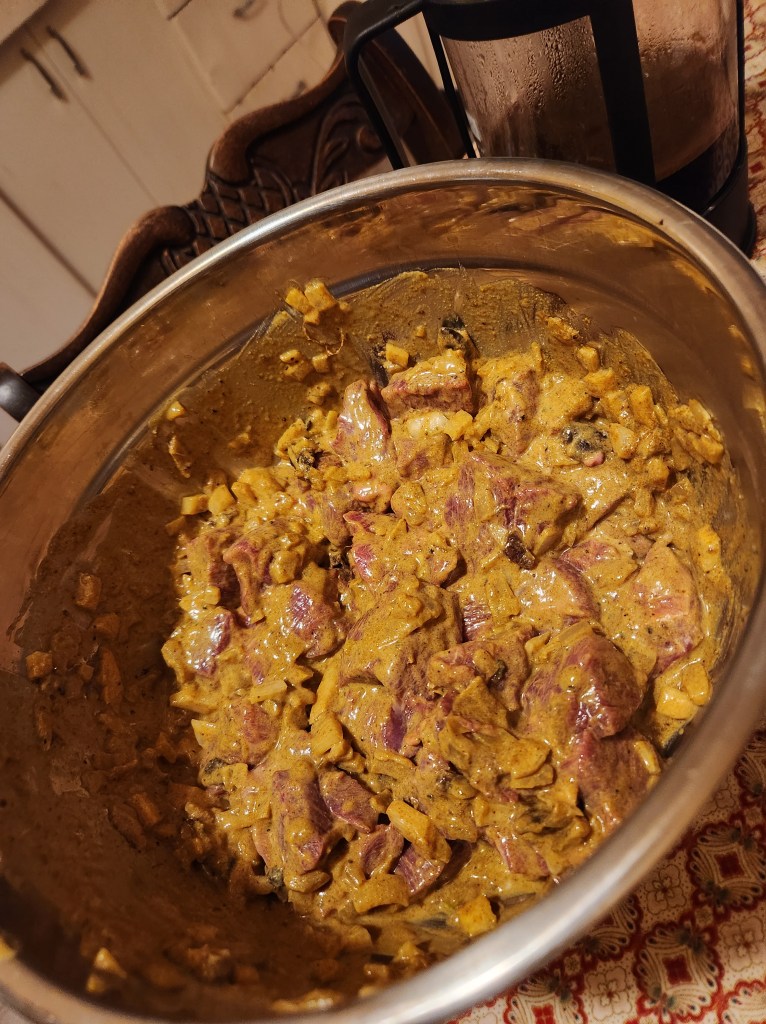
What moves in the mind of a man while he sleeps? I woke with a shudder at 5:17 AM. I had but one objective, one reason for being: to cut the leg of lamb into manageable cubes and marinate it. Yes, I had a full day of actual, out in the world, making the Benjamins, work ahead of me, and if I’m gonna throw down some kebabs for suppa, my guests deserve well-marinated ones. As I explained in the last cliff-hanger, Ms. Duckitt transcribed the recipe for this dish, and the marinade, a South African creation, is key to its success. Tamarind paste is wonderful, subtly sour and fruity, plus curry powder. I used a Japanese curry powder that balanced in sweetness the sour of the tamarind. Lemon zest, salt, onion, and milk. Yes, milk. Lactic acid helps tenderize the meat. Buttermilk fried-chicken is familiar, no?
Thar she blows, kids. I let them sit in the fridge all day long while I worked. I came home to a very satisfying activity- skewering meat. That feeling of piercing flesh with a sharp stick is very stress relieving. I was surprised, delighted, and impressed with how my kebabs looked exactly like what I imagined, and how it felt to set the skewers on the grill.
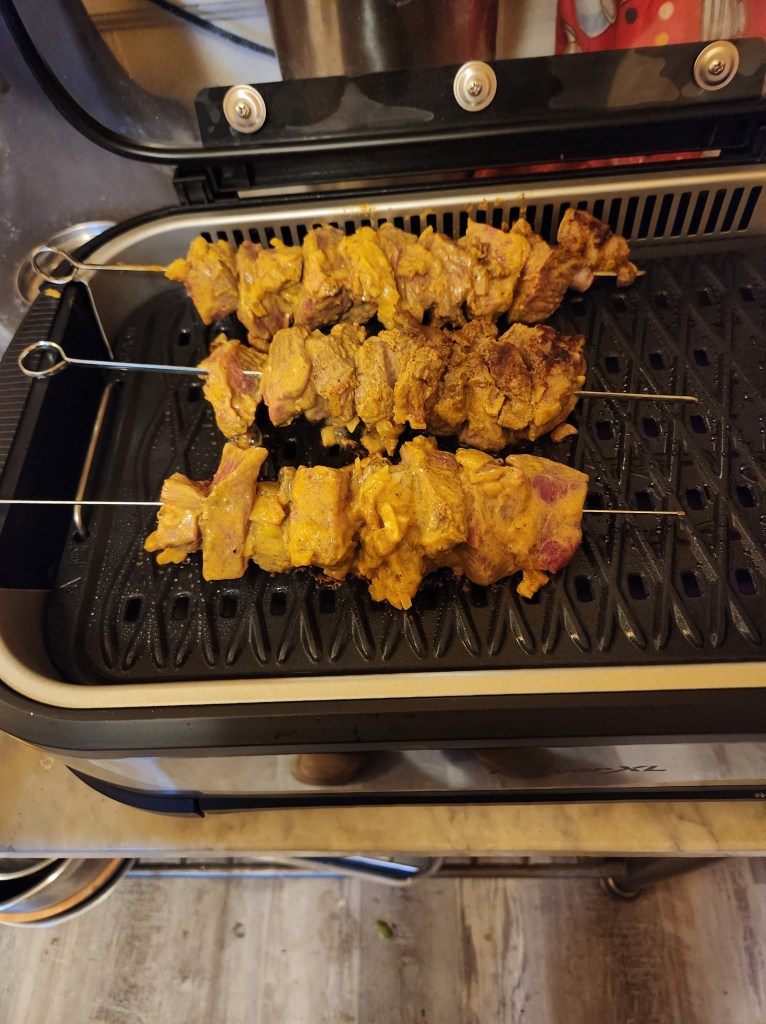
There they are, a’grillin on the grill. It is a different type of cooking. When something is in the oven, it’s like patiently waiting for someone to give birth. It takes its time, it happens in secret, and when it is ready, forth it comes. Grilling happens right in front of you, and like cavepersons of old, I intently watched the meat get its char, on all sides. It’s more celebratory, immediate, the scent of the marinade grilling was seductive.
There was only one little issue I encountered. Maybe a friend can help me out. When I went to flip the skewers over to grill another side, the skewer would flip but the meat would not. Perhaps that’s what happens when you get the cheapest metal skewers money can buy. The bamboo sticks are a real pain in the patootie cause they frequently snap under the weight of the meat, and even if they’ve been soaked thoroughly, they still dry out and burn before the meat is all cooked. I’ll do a little investigating and see how I can fix this.
Oh gosh golly, I just did and you know what? I figured out how to fix the problem-double skewer the meat. Now these are flat skewers but thin, so put one through one way with the ring on the left and the other with the ring on the right, and flip both skewers at the same to to fliperoo the meatarino. Problemo solved.
Wait a minute, wait a minute here. I am reading this post-in-progress, and a friend has indeed come through. Miraculous! The meat needs to be grilled for a few seconds and flipped, then flipped and flipped at regular but increasingly longer intervals so the meat doesn’t get heavy on one side, gravity pulling that side to the earth instead of flipping with the skewer! Thank you muchly!
There it is, the full meal, human hand for scale. From the top, cucumber salad, purple onion, salt, mint, yogurt, vinegar. Clockwise looking, the deskewered meat chunks, juicy tender, cooked medium. Bottom center, Khichri, red lentils, basmati rice, fresh from a friend’s garden fava beans, tamarind paste, and a heaping helping of crazy and diverse spices. TEEERIFIC! Finally, the Naan. The dough could have used a little bit more kneading, and the first batch I overcooked making it more like a crisp thin pizza crust. The subsequent batches were good, though they were a little thick, I could have stretched them out a bit more. Someone suggested a touch more salt. These imperfections aside, the bread was tasty and everything. Nothing was left for today.
Well, except for one thing. Unbelievable. I forgot to serve dessert. I realized I didn’t quite have time to make the Junket, and the primitive recipe with lots of guessing made me anxious, so as the ole saying goes “go with what you know”. By the way I should tell I’m thinking of going Cormac McCarthy on you all and stopping using quotation marks. Back to the subject- a Junket was no longer in the cards. But I wanted something spiritually related, a light, cool, pudding with something bright and a funny sounding British name. I swapped cinnamon for Meyer lemon and milk and rennet for cream and sugar and made a Posset. They look so clean and creamy and beautiful in their little ceramic custard cups gently wobbling when commanded. That’s where they are sitting right now. I forgot to serve them, I haven’t been serving dessert at regular meals all the time, so it’s natural that no one would ask about it.
Here, then is a solution. This same friend arrived a grand box of tomatoes, tight fresh green bell peppers, and other sundry goodies. There is some leftover Khichri in the fridge, tomorrow night we’ll have vegetarian stuffed bell peppers and the lemon posset.
In the meantime, I really like this grill, and I’m very happy that it is here in time for summer. I want to grill lots of things. More and more to come.
If music be the food of love, play on. Happy Birthday, Will! Oh that you were with us still. Here’s what I got today:
What Shakespeare was to play-writing, Elizabeth David was to cookery writing. She was just as British, too. One of her best books, Spices, Salt, and Aromatics in the English Kitchen, is the basis for this week’s menu. This book has a beautiful little section on kebabery. And boy did I find something fun.
I’ve always been excited by dishes that have poetic names or are named after people or occasions. The French and Italians enjoy naming things after famous people, like Crepes Suzette or Pizza Margarita. Every pasta shape has its own cute little name like orecchiette (little ears), farfalle (butterflies) and my favorite, Strozzapreti (priest strangler). Chicken Marengo. In Chinese cooking, there are wonderful names for dim sum and noodle dishes like Lion’s Head meatballs, Dragon Noodles, Dragon and Phoenix, a great dish of mushrooms and cabbage and sesame oil called Three Winters. I remember as a kid we’d go to the House of Hunan in Fairlawn Plaza (you can fill in the Midwestern suburb, American/Chinese restaurant, and mall/plaza/outlet that applies to you) someone would order Happy Family and I’d wonder why everyone didn’t eat it if makes the family happy. Some items have names that are meant to be funny like Nun’s Farts or Rocky Mountain Oysters. Nipples of Venus. The British really take the cake with hilarious names-Eton Mess, Bangers and Mash, Bubble and Squeak, Rumbledethumps, and that perennial giggle-giver, Spotted Dick. So, I’ve found three dishes in this great little book that I think will taste harmonious together and have clever names that have a nice rhythmic lilt. Here is the menu and a brief description.
Sassaties, Khichri, and Junket. That’s it. That’s it, my friends. Sound yummy? It could be the name of a law firm. Well, let’s investigate. So, Sassaties. What are they, where did they come from? Sassaties are South African kebabs made with lamb marinated in tamarind paste, curry powder, onion, lemon, and milk. After a day or so the marinated cubes of meat are threaded on kebab sticks and grilled. There is almost zero information on this recipe. There are only two in the database collection of over two and a half million recipes. There’s one with apricots in the Joy of Cooking, and this one. No other recipes for this dish, anywhere, zippo, zero, notta, nothin. Elizabeth David writes that she discovered the recipe in a cookery book from 1891 entitled Hilda’s Where is it? by Hildagonda Duckitt. So, I need to find out who Hildagonda is.
Well, put simply, Hildagonda was South Africa’s first celebrity chef. She is known for her two books Hilda’s Where is it? and Hilda’s Diary of a Cape Housekeeping. She is considered an important chronicler of daily life in Victorian South Africa. You knew it had to be someone. Anyway, I may need to find a copy of those books and check them out.
She doesn’t seem to be particularly interesting, life-wise speaking. She wasn’t thrown as an infant from a burning apartment building; she wasn’t raised by bears. She was just a grande dame of Capetown living, and she knew how to throw a party and write a couple of books about it. I like her look, though. Very Victorian-hip.
Now Khichri or more commonly spelled Khichdi is a familiar dish to many in South Asian cuisines, lentils and rice and all manner of spices. Earliest mention of it dates way back to good ole 305 BC. I think these two dishes will go well together even though they grew up so far away from each other.
I ate a large bowl of minestrone soup made with my own delirious turkey stock and realized I really needed to take a walk, get my butt movin and go to the local market and get some of that kebab stuff.
The Rite Spot, a delightful tavern in the Mission District, near Gus’s Community Market, a delightful grocery store in the same neighborhood. I passed it on my way home, leg of lamb in hand. I was not able to find certain other ingredients and decided to go to one of several local Produce Markets that carry large quantities of spices and other less usual things like Tamarind Pulp. Which I got.
Tamarind pulp comes from tamarind pods surprise surprise and is a popular ingredient in African and Asian food. It is also an essential food to the survival of the African ring-tailed lemur, so I hope it’s not too popular! Anyway, the pulp is for paste, and I’ll know how to prepare that in the coming days. It will be included in both the kebab marinade and the rice and lentil dish. OK, more to come. I can’t give it all away in one writing! You!
Another cold, wet, windy Saturday here in San Francisco. A great time for research. That’s right, friends we’re picking up where we left off in Kebabville. First, a gentle off-topic reminder. Always pull the book off the shelf by its sides, not down from the top of the spine. I remember this because several years ago I bought a book called the Turkish Cookbook. It is a thick red hardcover cookbook loaded with items I’m not likely to serve to my guests, like ram’s testicles and whole sheep’s head. It’s not that I’m not up for an adventure, it’s the leftovers I fear most. I imagine everyone would take a polite little nibble of ram’s nut on a skewer, and I’d be the one eating them for breakfast lunch and dinner for the next four days.
At any rate, I had this book taking up space on the shelf, half or whole knowing that I would not be cooking from it ever. Plus, one day, when I went to peruse it, I pulled the book off the shelf from the top of the spine and tore the whole binding off. After a pretty good job of package-taping it back on, I decided it would be one of the very small number of cookbooks that would have its next chapter at the thrift shop. That was four years ago. Ever since then, it has snoozed in a small pile of books destined for the charity shop and never quite making it there. It has been shunned, separated from the community of active cookbooks. It is in a closet.
Naturally, the subject of kebabs came up yesterday in our dinner conversation. The subject was Doner Kebab. I am not going to go into it right now, but Doner Kebab is similar to Gyro and don’t you need one of those rotating stand thingys with the heat lamp and a sword to shave it all down and where are you going to get a giant vertical rotisserie? Do you need a vertical rotisserie? Surely, there must be a recipe for this wonderful dish that has a homemade work-around. I investigate.
First thing, I return to the database where all of my cookbooks are indexed so I can search by recipe. I type Doner Kebab. Nothing. I am surprised. I type Gyro. One recipe. I am again surprised. I thought there’d be more. I leave my personal database and go a general cookbook index. This index has of this writing 167,816 cookbooks indexed. I type Doner Kebab. Out of the 2,550,773 recipes, 34 of them were for Doner Kebab. Many of the 34 recipes were weird and wild variations on Doner Kebab, including a mince pork Banh Mi, pressed duck, and a vegan type of deal no thank you bob. Of all the recipes I, well, skimmed, I found 3 recipes that seemed authentic and familar. One of them is from my big red Turkish cookbook destined for the charity shop and never quite making it there.
I have only ever regretted parting with a cookbook once, and that was when I gave my copy of The Jewish Cookbook by Claudia Roden away. Why did I do this? What was I thinking? I still search in used bookshops. What fool would give away their copy of The Jewish Cookbook by Claudia Roden? Well, this fool did. Maybe that’s why the little stack of books never makes it to the thrift shop. Someday, I will look for something, a new cooking challenge, something neglected, and realize that what I was looking for was in one of those books, and hadn’t that happened this morning? I leaped from the chez lounge and ran down the hallway. I opened what used to be a coat closet and is now a book warehouse. My eyes darted to and fro, scanning quickly every spine up and down and side to side. I see it, I grab it (carefully, carefully), I rush it my table and go quickly to the Doner kebab recipe, the first line of which reads as follows: For this recipe you will need a large vertical rotisserie.
Having crested my turkey wave, I’d been at a bit of a loss to come up with a new food frontier. Last night, in a dream, it came to me. It is time to confront my thing with kebabs. In vivid detail, at a tented food cart out on the street, I was cutting vegetables, forming meat around stainless steel skewers and setting them tenderly on a grill. When I woke up this morning, I fully expected there to be kebabs for breakfast in my kitchen. Peace, peace, Mercutio, I talk of dreams which are the children of an idle brain. Still and all, I believe my time with kebabs has come.
I remember my mother occasionally making them when I was a kid, which was not too exciting in my opinion grown-up food. It seems to me as my tastes expanded, I loved foods that were mixtures of things. A stew, or quiche or vegetable stir-fry, an amalgam of shapes, flavors, textures. Sauces, secret ingredients, surprise additions. Flavorful formulae, magical potions devised by Merlin. Kebabs, are of course, an anti-mixture. By nothing less than the point of a sword these items are ruthlessly segregated. The clump of meat tastes like a clump of meat, and the crunchy vegetable tastes like crunchy vegetable. No mystery, no subtlety, no perfume, just hacked up bits on a stick. To me, I didn’t like pulling the charred morsels off the skewer, some of which would stick, leaving little shreds of meat behind. Or the mushroom would resist, only to go flying off across the room when I tried to pry it. What a hassle. So, inspired by good sleep, I am going to explore my relationship with kebabs. OK, back to this in a second. First things first.
I have come into a great bounty of oranges. It is a great thing, but also a bit of a tragedy because I am in competition with the white and blue mold that quietly develops on the bottom of the oranges at night to consume them. Before any other activity today, I processed all those babies. Now, I have a red kettle full of candied orange peel, and a large pitcher of wonderful tart juice, which I am sipping now. What a treat. Next, a glut of bell peppers and hot house tomatoes. What to do? Well, of course, we’re having black bean veggie tacos for lunch! Finally, three rotten bananas. Banana bread. These clear the table space and head space for kebabs to come.
Now wait a minute here. My mother makes the kebabs known as Shish. I found a website that says “Let’s explore the 21 most popular types of kebabs”. There are a least 21 types of kebab. Great, there goes my summer. Shish kebabs are not the ones I was making in my dream. Kebabs originate in whatever country the recipe writer comes from. I have recipes for Russian, Turkish, Greek, German, Iranian, Persian, Egyptian, and Brazilian kebabs, not to mention the French and their precious brochettes. There is even a US State, South Dakota to be exact, which has its own unique variation called Chislic kebab. So that is where they come from. Shish is the most popular in the United States. It is widely believed to have come from Turkey and is the cubes of meat and vegetables on skewers. What kind was I making in my dream? It was like a meatball paste mixture which is molded around the skewer. OK, I found it. I was making Shish kofte kebabs. Sheesh! Shish kebabs are typically made with cubed lamb. Mother uses cubed beef, a variation called Basturma, which originated in Russia. I feel like I may have lifted Pandora’s grill lid here.
Day is done, and my black bean chili was delightful. I used a green Chile blend I got from Oaktown Spice Company and it is tangy, sour, and piquant. Yes, piquant is the word. More to come.