11 November 2025 Tuesday
I know you’ve seen this: An online article with the headline “What California city is the best place to retire?” and above the headline is a photograph of the skyline of Atlanta. Or how about this: an article with the headline “Miley Cyrus fans shocked to hear devastating health news” only to discover that her Pekingese has asthma. Each of these is a manipulation, a lie that is told on purpose presumably because people don’t know what the skyline of Atlanta looks like, or they don’t know Atlanta is not in California, or they don’t care. Someone assumes it doesn’t matter.
In the latter case, a preying on the emotionally confused, who may not have been devastated by Miley Cyrus’ news about her pet, but are now devastated because they assume that all of her other fans must be devastated and you don’t want to come across as either not a great fan or an unsympathetic person, so you are devastated by the news too. The type or types of person that are likely to be moved by this headline also are frequently unable to have a hierarchy of feelings, conflating say, the dog’s asthma with genocide in Sudan, describing both as “devastating”. In the twenty years I have lived in California, I have noticed residents love this word. Here are a few of what I am coining “California sentences”. 1. Neighbors were devastated to learn that the children were found dead in the bed with their parents, all having been shot in the head at close range. 2. The community is devastated to learn that Ernie’s hot dog stand will not be participating in the county fair this year. 3. I was devastated to hear that the children’s pictures would be displayed in the side hallway, not in the main room, where they were displayed when I was a student here and it’s just not the same.
Now, that’s a lot of devastation, I’m surprised that people are able to keep going. Which came first, the event, the headline, or the feeling? Sometimes I wonder at my own emotional response to media.
I remember when I learned that what I read in the paper was not necessarily true. “Your family won’t believe how delicious this dish is, or that it is made with broccoli! They will be asking for seconds!!” I was twelve years old and just starting to cook from recipes and go off on my own little directions, and I came across this recipe in the local newspaper. It was a pasta dish with a garlic broccoli sauce of sorts. It was published in print, it sounded lovely, everyone in our little family liked the ingredients, and it promised to elicit a certain and positive response from the people eating it. It did not do this.
The recipe was flawed; all the measurements were off, that much I do remember. It made a tiny amount of burned sauce, and we ended up opening a jar of regular old tomato sauce and pouring it over the spaghetti. But for a twelve year old boy, it was, well, devastating. I followed the recipe to the letter of the law, and it had failed. It took a while for me to realize that the flaw was in the recipe itself, which had obviously not been proofread or tested. It made me wish that they had done both of those things instead of writing the useless and inaccurate claim that we’d love it.
Doesn’t this happen to us all the time? We are lead to believe that something terrible has happened to Miley Cyrus herself, and we open the article to see what it is, and if she is OK, only to be deceived because it’s not about her, it’s about her dog. And yet, to the people that adore everything about her, the news about her dog IS big news. If the recipe doesn’t work and your family doesn’t love it, it’s our fault somehow. You must be moved with sympathy, you must love the recipe. Why can’t we eat it and judge for ourselves whether or not we like it? Or why can’t we decide how to feel about celebrity’s pets on our own, without knowing how other people are feeling, or how the people that write these headlines interpret what they think other people are feeling. How does this stuff get published?
OK, skip ahead thirty six years. I am looking for recipes for things that include pumpkin (excluding the soup served in the pumpkin) that aren’t pumpkin pie. I came across a curious recipe from a cookbook called The Complete Book of Greek Cooking, written by the good yiayias at St. Paul’s Greek Orthodox Cathedral, which must be a wonderful place. I did think it was a little unusual to find a pumpkin cake recipe in a Greek cookbook, I guess I didn’t know they had pumpkins in Greece, but you’re learning something everyday, aren’t you?
I thought I’d give it a try, and maybe make a whole meal out this book, because I had never made anything from this book I’ve had for years, and why not? Lamb shoulder was on sale at the market, and well, it just seemed like it was meant to be. I would make a roast lamb with oregano, and the recipe for Lentil Soup to start.
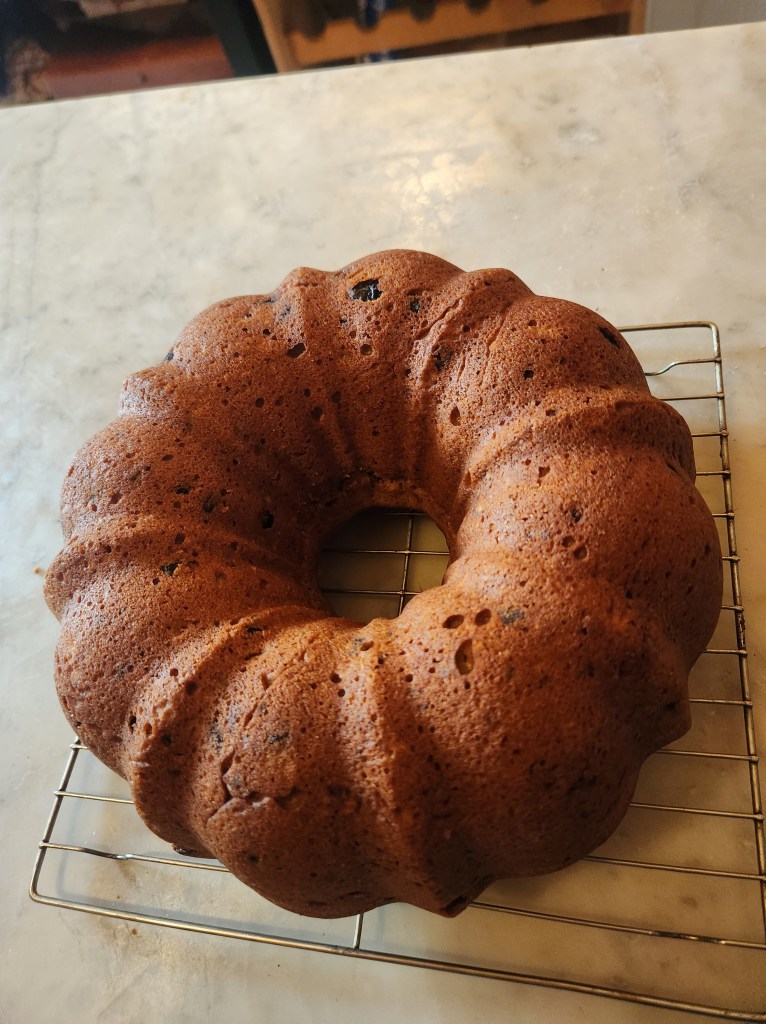
Well, there she is, that pumpkin cake I was telling you about. Pumpkin, walnuts, raisins, and a little of dark chocolate and cinnamon.
A few people came over for dinner and the announcement was made (I like to make announcements) that we’d be eating Greek food, or rather, that all the recipes had come from a cookbook called The Complete Book of Greek Food. As I was making this announcement, perhaps because I was hearing the words come out of my mouth, my heart sank a little. I felt like perhaps I was not telling the truth, I was being inauthentic. I was wanting my guests to believe that these were authentic Greek dishes because the print had convinced me that they were authentic. The Lentil soup was a lovely normal Lentil soup with nothing that occurs to me as being Greek. Someone asked what was Greek about this Lentil soup, and the only answer I had was that it was from this Greek cookbook, yiayia wrote it, and yiayia doesn’t lie.
The Lamb was a little more understandable. I mean, lamb, right, that’s Greek. Oregano? Yeah, sure.
The cake, as food, was easy to swallow. The cake, as Greek? Impossible. It tasted like an ordinary, dense, slightly dry cake that might be good with coffee, American coffee, and the kind that millions of non-Greek grandmothers might make all across the country. So, the food was good, maybe not too special, and even though I have no authority to say so, not at all Greek.
So, what do I make of all this? I did some research and read Amazon reviews of this cookbook, which was published in 1990. You may well ask why I am not cooking from a newer Greek Cookbook. Well, Greece has been around a long time, and i would think that an authentic cookbook would not have changed much from 1990 (the year I made that terrible broccoli pasta) and today. Of course, some of the reviews were glowing, some of them were terrible, and at least one of them was very thoughtful.
The review that got me thinking was based on the idea that the yiayias who wrote this book were of Greek descent, but had lived in the United States for at least two generations. These yiayia’s yiayias were likely born in the United States, and they were raised on these recipes which, they were told, were authentically Greek even though they were likely authentically American. Is this a lie? Is this manipulation? Who committed the sin if there is any? The writers felt no need to validate their recipes because they believed they were authentically Greek. The publisher didn’t want to either, because then you’d either have to get rid of a lot of the recipes or put a book out there called “The Complete book of recipes that these people know” or “A book of assorted foods compiled for no particular reason” Or “A Complete book of false bullshit.” I probably would have bought a copy if it had been named that! But between these two reasons was another reason: the average person would not have known the difference. It was like looking at a picture of Atlanta and being told that it was a city in California. Most people either won’t know or care, and others will simply believe without question.
I wonder what else we read and believe because we’ve read it? Is your “trusted” news source the one that affirms your already held beliefs and feelings? Here’s what I do know:
- I will get rid of this cookbook. Sorry, yiayia.
- They do have pumpkins in Greece and eat them.
- Miley Cyrus has a lot of pets, none of whom have ashtma.
 BingoFest